
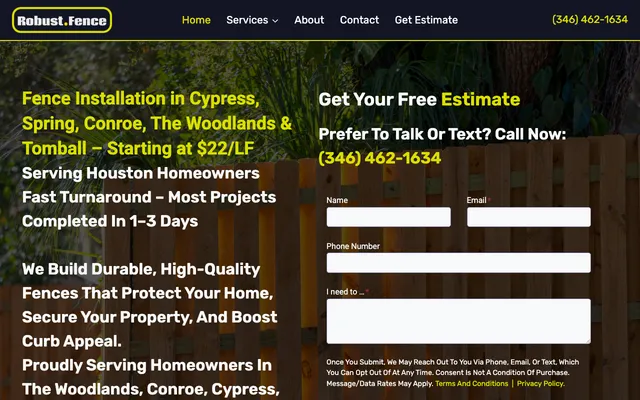
Fence contractor · Cypress & Spring
Robust Fence
0.9sFirst Contentful Paint on desktop
Read the case study→
You quote jobs, you do not sell products. So the website has one job: make requesting an estimate the easiest thing on the screen for a homeowner standing in their yard with a phone. Everything else on this page serves that.
A homeowner ready to ask for a price should never have to find a Contact page. If the form and the phone number are not on every screen, you lose the ones who were ready.
Hundreds of finished jobs sitting on a phone. A marketplace profile you share with forty other contractors does nothing with them, and neither does a site with four stock photos.
Angi and Thumbtack charge you for a lead they also sell to three competitors. A quote request from your own site rings one phone.
A four-field form on every page for the ones who are ready, and a longer detailed path — project type, dimensions, materials, add-ons, photo upload — for the ones who want to give you everything at once.
Your suburbs named in text where homeowners scan for them. Separate area pages only where there is real material — jobs completed, local considerations, actual photos — never a dozen copies with the town swapped.
Organised by job type, fast to load, easy for you to add to. Before-and-after pairs are the single most persuasive thing a contractor can publish, and almost nobody does it.
A tappable number in the header on every page and again at the bottom, because that is where someone lands after reading. Not an image, not behind a menu.
Same name, same number, same services on the listing and the site. For most local trades the profile drives more traffic than the website search results do, and mismatches cost you.
License number where your trade requires one, liability and workers comp confirmed, warranty terms in plain words, and a response-time promise you can actually meet.
Your real Google reviews with names and dates, plus a short review link you can text from the truck. Never bought, never incentivised, never written for you.
Form submissions counted as conversions, phone taps counted, both attributable to a landing page — so you can tell which service page earns its place and which is dead weight.
Most of them are brochures. They describe the company, list the services, and finish with a Contact page nobody visits. They get traffic. They generate almost nothing. The owner concludes websites do not work for their trade.
The gap is rarely design. A brochure site is organised around the company; a lead-generating site is organised around one question — how does a homeowner on a phone start a quote in the next ten seconds? Everything below is an answer to that.
They have three tabs open. They are comparing you against two other contractors they found the same way. In about four seconds they are deciding whether you do their job, whether you cover their suburb, and whether you look like you have done it before.
That is the whole brief for the top of your homepage. Trade, area, and one signal of speed or scale: “Fence installation and repair across Cypress, Spring and Tomball. Free estimates in 1–3 days.” Not “quality craftsmanship since 1998” — that is a trust signal, and it belongs further down, after they know you are relevant.
Two forms, doing two jobs.
The short one goes on every page: name, phone, ZIP or suburb, what they need. Four fields. Every additional required field costs you submissions, and a homeowner asked for square footage and preferred start date before you have earned anything will close the tab.
The detailed one is for the ones who want to give you everything at once: project type, dimensions, materials, add-ons, photos of the site, timeline. Some homeowners are ready to be specific. Let them, and you get a qualified lead instead of a name and a number.
The strongest version is an instant estimate — the homeowner answers a few questions and gets a price range on the spot. It sets expectations before you spend a site visit and it converts better than “we will get back to you”, because it gives something immediately. We build these with QuoteSpan, which is a Graphcast-owned product; that is disclosed here rather than presented as neutral advice.
Name your suburbs in text on the page. Not on a map image — text. Homeowners search “fence company Cypress TX” and they scan for their own suburb before reading a word of your copy.
Separate pages per area earn their place only where you can say something real: jobs completed there, local conditions, actual photos from that side of town. A dozen copies of one page with the suburb swapped is the oldest thin-content trick there is.
Homeowners buy what they can see. A gallery organised by job type, with a caption saying what it was and roughly where, does more work than any paragraph you could write.
Before-and-after pairs are the most persuasive thing a contractor can publish, and most contractors skip them because it means remembering to take the “before” shot. Make it a habit: same angle, same time of day, whole job in frame. Six good pairs win more work than a redesign.
Twenty well-shot photos beat two hundred blurry ones — and uncompressed phone photos are the single most common reason a contractor site loads slowly.
State your license number where your trade requires one. Say you carry liability insurance and workers’ compensation. State your warranty in plain terms: what is covered, for how long.
A homeowner letting a stranger onto their property is managing risk. Answering those questions before they are asked removes a reason to hesitate. Publish only what is true and current.
The number belongs in the header on every page, tappable, and again at the bottom. Most contractor traffic is a phone, often on a weak signal in a driveway. If the page takes six seconds to render, a real share of visitors are gone before they see any of this.
For most local trades, the Google Business Profile drives more traffic than the website’s own search results do. Claim it, verify it, choose the primary category on evidence rather than instinct, fill in the services, load current photos, and link it to the site.
The profile and the site must agree — same name, same number, same services. On the site itself, the fundamentals are unglamorous and non-optional: unique titles and descriptions per page, suburb names in headings where they are true, schema markup describing the business and its service area, a sitemap, and pages that load fast on a phone.
Costs and the full process are in our Google Business Profile setup cost guide.
Pull your Google reviews onto the site with names and dates. Three specific reviews that mention the actual job beat twenty generic five-stars.
Leave with a short review link you can text from the truck and a rule about when you ask. Never buy reviews, never incentivise them, never write them yourself — Google is good at detecting it and a suspension costs more than the reviews were worth.
If you cannot count leads, you cannot tell a good month from a good story.
Form submissions fire a conversion event. Phone taps are counted. Both are attributable to the page the visitor landed on. Then you know whether the gate repair page earns its place, and whether your ad spend produces quote requests or just traffic.
A ZIP or suburb field filters out-of-area requests. A project-type selector routes the job. A budget or timeline question — optional, never required — tells you who is ready.
Every qualifying question costs you a few submissions. Ask the two that save you the most driving, and stop.
Flat, published, and the same for everyone.
Copywriting is included. Photography is not — we use your photos, which is also why they matter. The domain stays in your name. Hosting after launch is free if you host it yourself, and we help you set that up.
The full process, timeline and what we need from you is on the process page, and every price with what it does and does not include is on the pricing page.
No guaranteed leads. No guaranteed Google ranking. No guaranteed spot in the map pack. Those depend on your market, your reviews, your competitors and time — not on what any web designer builds. Anyone quoting them is quoting something they do not control.
What a flat price here buys is a fast, correctly structured site aimed at the searches your customers actually type, with the estimate path made as short as it can be, and tracking that tells you honestly whether it is working.
Most fence and construction companies fit the Business Site at $1,950 flat: a home page plus a page for each service you want more of. A single-trade operator testing the water can start with the Launch Page at $650 and upgrade later without a rebuild. Full detail is on the pricing page, and the market context is in our Houston website cost guide.
Both, because they catch different people. Someone with a fence down after a storm calls. Someone planning a project in six weeks, on their phone at 9pm, will not call a stranger — they fill in a form. The number goes in the header on every page and the short form goes on every page, so neither one is a detour.
Yes. A homeowner answers a few questions — linear feet, height, material, gates, add-ons — and gets a price range immediately, then a lead lands in your inbox already qualified. We build these with QuoteSpan, which is our own product; that is a disclosure, not a neutral recommendation. It is what powers the estimate form in the Robust Fence case study.
No, and doing it badly hurts. Area pages work when you can write something genuinely specific — jobs you have completed there, local considerations, real photos. A dozen near-identical pages with the town name swapped is a thin-content pattern search engines have handled for a decade. Start with one strong page for your main area and add others as you build real material.
No, and neither can anyone else. Rankings depend on your competitors, your reviews, your Google Business Profile and how long you have been established. What a site controls is the part that is controllable: speed, structure, service pages aimed at real searches, and a profile that matches. We will not sell you a ranking promise, and you should be wary of anyone who does.
Those platforms own the customer relationship and sell each lead several times over. Your own site ranks under your own name and trade, and every quote request from it is exclusively yours. Most contractors run both for a while and lean on the site as it picks up traction.
A one-page site is live in about a week. A full contractor site with a page per service takes two to three weeks. The clock starts when your photos and service list arrive, not when the deposit clears — gathering content is what actually decides the timeline.
Call and talk to the person who will actually build your site. Or send the form and we'll call you back with a flat quote within one business day.
Serving Houston and the Greater Houston Area
Tell us what you need. We reply with a flat price, not a sales call.